
China’s Fluid Thickener industry is expanding with food processing, pharmaceuticals, cosmetics, and industrial formulations. Demand is visible in factory tanks, sauce lines, toothpaste tubes, and ready-to-drink beverages.
Grand View Research valued the global hydrocolloids market at approximately USD 11.29 billion in 2023. Its report also projects continued growth through 2030, supported by changing diets, convenience foods, and cleaner-label formulations. MarketsandMarkets identifies hydrocolloids, starches, cellulose derivatives, and synthetic polymers as important thickening materials. However, market estimates differ between reports. Definitions are not always consistent.
Professor Peter A. Williams, a recognized food hydrocolloid researcher, describes hydrocolloids as “water-soluble polymers.” This simple definition matters. A Fluid Thickener must control viscosity, water retention, suspension, mouthfeel, and processing stability. One product may perform well in cold water but fail during heating. Another may create excellent thickness but leave a noticeable aftertaste.
This guide examines China’s top ten Fluid Thickener manufacturers through practical criteria. These include production capacity, raw-material control, formulation support, certifications, export experience, and application testing. Company size alone is insufficient. A larger factory may not provide the best solution for every formula.
The shortlist should therefore be treated as a research starting point, not an absolute ranking. Supplier claims require verification. Buyers should request technical data sheets, sample batches, traceability records, and performance tests under real production conditions. Small differences in particle size, hydration speed, or dosage can change the final product significantly.
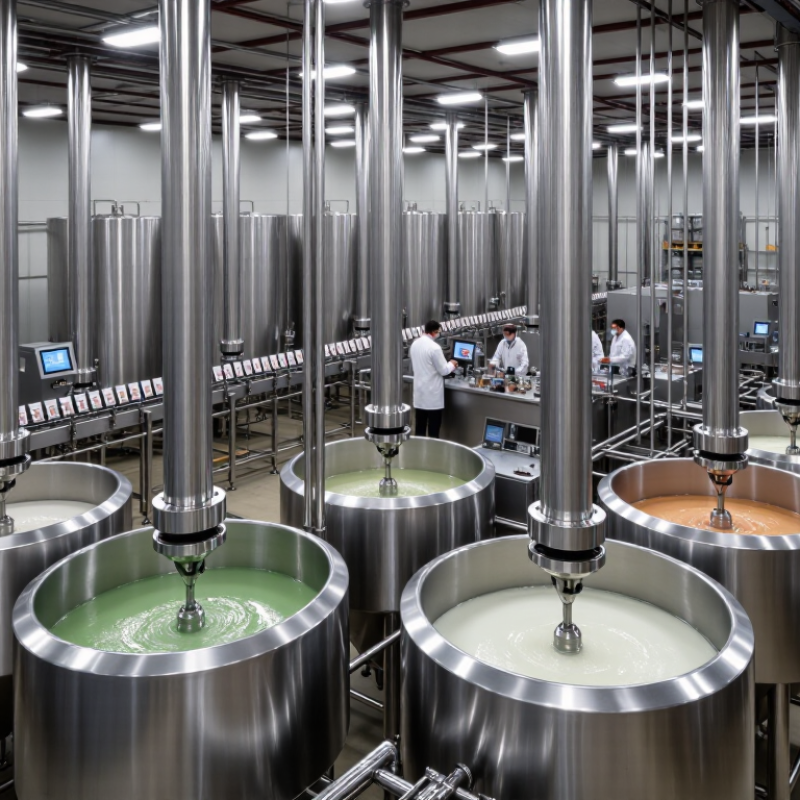
A fluid thickener is a material that increases a liquid’s viscosity without turning it into a solid. It helps control flow, texture, suspension, and product stability. Common types include cellulose derivatives, natural gums, clays, and synthetic polymers. Each behaves differently under heat, salt, pH changes, and mechanical force. A thick liquid may still flow easily when stirred or pumped. This behavior is called shear thinning.
You can find fluid thickeners in coatings, detergents, personal care products, construction mixtures, food processing, and agricultural formulations. In wall coatings, they reduce dripping and improve brush control. In cleaning liquids, they help the product stay on vertical surfaces longer. In lotions, they create a smoother feel and slow ingredient separation. Some industrial fluids need thickening to keep solid particles evenly dispersed. Small dosage changes can alter performance significantly.
In practical testing, I would compare viscosity at different shear rates, temperatures, and storage periods. A sample that looks stable after one day may separate after several weeks. That detail is easy to miss. Compatibility also matters because salts, preservatives, and active ingredients can weaken a thickener. The best choice depends on processing equipment, target texture, cost, and safety requirements. A thicker formula is not automatically better. Over-thickening can cause poor pouring, trapped air, or difficult pumping. Laboratory results should be checked against real production conditions.
China’s fluid thickener industry is organized as a layered supply chain rather than a single, uniform market. Upstream producers supply cellulose derivatives, acrylic polymers, mineral suspensions, and other functional materials. Specialized formulators then adjust these materials for coatings, detergents, construction fluids, personal care products, and industrial processing.
The leading manufacturers usually compete through application knowledge, production scale, and quality control. Some operate large standardized plants, while others focus on customized grades for specific viscosity, temperature, or shear conditions. A typical factory may test appearance, pH, solids content, viscosity, dispersion speed, and storage stability. Batch records and traceability are also important for international buyers. Small details matter. A delayed viscosity reading can change a purchasing decision.
Distribution adds another layer. Export teams, regional agents, technical laboratories, and contract processors connect manufacturers with overseas users. During factory evaluations, buyers often inspect mixing tanks, dust control, sample retention, and wastewater procedures. Certificates help, but they do not replace practical testing. A thickener can perform well in a laboratory and behave differently in a customer’s formulation. This remains an imperfect part of supplier selection. Trial batches, clear specifications, and regular communication reduce that uncertainty. Price alone rarely explains the real difference between China’s top ten fluid thickener manufacturers.
Representative manufacturer segments ranked by application breadth and supply-chain relevance; company names and brands are intentionally omitted.
| Rank | Anonymous Manufacturer Segment | Primary Thickener Chemistry | Main Fluid Systems | Typical Use Level | Key Applications | Common Chinese Production Cluster | Typical Supply-Chain Role |
|---|---|---|---|---|---|---|---|
| 1 | Hydrocolloid-focused producer | Xanthan gum and related microbial polysaccharides | Water-based, saline and mildly acidic fluids | 0.1–1.0% | Food sauces, drilling fluids, personal care and agricultural formulations | Shandong and Northwest China | Bulk export, food-grade supply and industrial formulation support |
| 2 | Cellulose-ether producer | Carboxymethyl cellulose, hydroxyethyl cellulose and methyl cellulose | Aqueous coatings, detergents, construction slurries and drilling fluids | 0.2–3.0% | Paints, tile adhesives, oilfield fluids, ceramics and detergents | Shandong, Jiangsu and Henan | Integrated chemical processing and customized viscosity grades |
| 3 | Synthetic polymer thickener producer | Cross-linked polyacrylates and acrylic acid copolymers | Water-based cosmetic, coating and cleaning formulations | 0.1–2.0% | Skin-care gels, shampoos, detergents, coatings and inks | Jiangsu, Zhejiang and Guangdong | High-value formulation ingredients and private-label industrial grades |
| 4 | Associative rheology-modifier producer | Hydrophobically modified ethoxylated polymers and urethane thickeners | Latex paints, waterborne coatings and specialty cleaners | 0.2–2.5% | Architectural coatings, industrial coatings, inks and adhesives | Shanghai, Jiangsu and Guangdong | Technical service, formulation testing and coating-grade supply |
| 5 | Mineral rheology-additive producer | Bentonite, attapulgite and sepiolite clays | Drilling muds, water-based coatings, inks and suspension fluids | 1–8% | Oil and gas drilling, foundry systems, paints and civil engineering | Inner Mongolia, Gansu, Liaoning and Xinjiang | Mineral extraction, milling, activation and regional distribution |
| 6 | Organoclay and organo-mineral producer | Organically modified bentonite and hectorite | Solvent-based coatings, lubricating greases and non-aqueous fluids | 1–5% | Industrial paints, inks, sealants, greases and drilling additives | Liaoning, Jiangsu and Shandong | Specialty modification, dispersion control and industrial distribution |
| 7 | Silica-based thickener producer | Fumed silica and precipitated silica | Resins, sealants, adhesives, coatings and grease systems | 0.5–8% | Silicone sealants, epoxy systems, inks, rubber and lubricating grease | Jiangsu, Zhejiang and Shandong | Performance additive supply with particle-size and surface-treatment control |
| 8 | Starch and plant-polysaccharide producer | Modified starch, pregelatinized starch and plant gums | Food, pharmaceutical, paper and water-based industrial fluids | 0.5–6% | Food processing, paper coating, pharmaceuticals and textile sizing | Henan, Shandong, Heilongjiang and Anhui | Agricultural raw-material processing and cost-sensitive bulk supply |
| 9 | Polyurethane and specialty emulsion producer | Waterborne polyurethane, acrylic emulsions and polymer dispersions | Coatings, adhesives, textile finishes and leather chemicals | 1–10% | Flexible coatings, laminating adhesives, textiles and synthetic leather | Zhejiang, Jiangsu, Guangdong and Fujian | Application-specific formulation and downstream co-development |
| 10 | Oilfield and construction-fluid additive producer | Polyacrylamide, starch derivatives and composite fluid-loss additives | Drilling muds, fracturing fluids, cement slurries and mineral suspensions | 0.1–3% | Oilfield services, tunneling, mining, wastewater treatment and cementing | Shandong, Henan, Sichuan and Shaanxi | Project-based supply, field testing and performance-driven contracts |
Note: Use levels are typical starting ranges and vary according to polymer grade, solids content, pH, temperature, shear rate and the target rheological profile. Production clusters indicate commonly recognized chemical, mineral-processing or downstream manufacturing concentrations rather than individual company locations.
Ranking China’s top 10 fluid thickener manufacturers requires more than comparing factory size or export volume. A credible assessment begins with product performance. Key indicators include viscosity stability, dispersion speed, temperature tolerance, and compatibility with different liquid systems. Test data should come from controlled laboratory procedures, not attractive sales claims. Small details matter.
Manufacturing experience also deserves close attention. A reliable supplier should show consistent batch records, traceable raw materials, and documented quality controls. Independent certifications can support credibility, but they should not replace technical verification. Strong manufacturers usually provide application guidance, sample testing, and clear adjustment advice. Their technical teams should understand mixing speed, pH changes, storage conditions, and dosage limits.
Production capacity must be reviewed alongside flexibility. A large facility may deliver volume, yet struggle with customized specifications or urgent changes. Ranking criteria should include pilot-scale support, delivery reliability, packaging quality, and communication during complaints. Customer feedback is useful when it describes measurable results rather than vague praise. Sustainability practices, worker safety, and waste controls also reflect operational maturity. No ranking is flawless. Public information can be incomplete, and some performance differences appear only after extended field use. A careful buyer should request recent test reports, trial samples, and references from comparable applications before making a final judgment.
China’s Top 10 Fluid Thickener Manufacturers
China’s fluid thickener sector serves coatings, construction chemicals, personal care, mining, and water-based formulations. A credible top-ten list should not rely on factory size alone. Production consistency, technical support, and documented quality controls matter more.
Experienced buyers usually compare cellulose ethers, acrylic thickeners, polyurethane grades, and mineral-based products. Each type changes viscosity differently. A coating may need smooth flow, strong sag resistance, and stable storage after opening. A drilling fluid may require salt tolerance, temperature stability, and controlled filtration. These details expose weak product matching quickly.
Reliable manufacturers normally provide technical data sheets, safety documents, batch records, and sample testing. Their laboratories should measure viscosity, moisture, pH, particle size, and dispersion time. Factory visits can reveal practical details, such as clean powder handling and sealed packaging lines. I would also check whether pilot trials use the customer’s actual water and mixing equipment. Laboratory results can look impressive but fail in production. No ranking is perfect. Export experience, response speed, and corrective-action records deserve careful review. Suppliers that explain limitations often appear more trustworthy than those promising universal performance.
Typical formulation dosage ranges for ten fluid-thickening technologies commonly supplied by manufacturers in China. The ranges are expressed as percentage by weight of the finished formulation and are intended for technical comparison rather than company ranking.
Lower dosage does not necessarily indicate stronger performance, because thickening efficiency depends on chemistry, pH, temperature, shear rate, and the target application.
Choosing among China’s top fluid thickener manufacturers requires more than comparing prices. MarketsandMarkets estimates the global rheology modifiers market will grow steadily through 2030, driven by coatings, construction, and personal care. This growth increases supplier choices, but quality can vary. I recommend checking viscosity curves, shear stability, temperature resistance, and batch consistency. Ask for technical data from at least three production lots. A glossy sample proves little.
Tips: Request a complete technical data sheet, safety data sheet, and certificate of analysis. Confirm the testing methods and laboratory equipment. During supplier audits, inspect raw-material storage, mixing tanks, filtration, and filling areas. ISO 9001 certification helps, but it does not replace process evidence. The ISO Survey 2023 recorded more than 1.4 million ISO 9001 certificates in China, so certification alone cannot identify the strongest manufacturer. That number is impressive, yet easy to misunderstand.
Evaluate delivery reliability through documented lead times, reserve capacity, and export experience. Ask whether the supplier can adjust solids content or viscosity without changing performance. Independent laboratory testing is valuable for high-volume purchases. A small pilot order may reveal sedimentation, odor, or packaging leakage. I have seen buyers focus on unit cost and overlook dilution performance. That mistake becomes expensive later. Compare total delivered cost, technical support, replacement policy, and response time. A supplier who answers difficult questions clearly is often safer than one offering the lowest quotation.
Product performance should lead the review, not factory size. Important measures include viscosity stability, dispersion speed, temperature tolerance, and system compatibility. Sales claims are not enough.
Stable viscosity helps a formulation keep its intended flow during storage and use. Testing should examine changes over time, temperature, and mixing conditions. Real production may behave differently.
Common options include cellulose ethers, acrylic thickeners, polyurethane grades, and mineral-based products. Each type changes viscosity in a different way. The cheapest option may not match the application.
Useful documents include technical data sheets, safety documents, batch records, and recent test reports. Testing should cover viscosity, moisture, pH, particle size, and dispersion time. Documents need checking.
Review traceable raw materials, consistent batch records, and documented quality controls. A factory visit may reveal clean powder handling and sealed packaging lines. Small details matter.
Mixing speed, water quality, pH, and storage conditions can change thickener performance. A trial should use the customer’s actual liquid and mixing equipment when possible. Laboratory results can mislead.
No. Large facilities may provide volume but struggle with customized specifications or urgent changes. Review delivery records, packaging quality, pilot support, and complaint communication. Capacity is only one piece.
Prefer feedback that reports measurable results, such as viscosity changes or storage stability. Vague praise offers limited evidence. Some differences appear only after extended field use.
Request recent test reports, trial samples, and references from comparable applications. Check response speed and corrective-action records as well. No ranking is flawless.
This article provides a practical overview of the Fluid Thickener industry in China, beginning with an explanation of what fluid thickeners are and how they improve viscosity, stability, texture, and flow control in industries such as food processing, pharmaceuticals, cosmetics, construction, coatings, and water treatment. It also examines how China’s manufacturers are organized, including raw material suppliers, specialized producers, customized solution providers, and export-oriented factories.
The ranking framework focuses on factors such as product quality, manufacturing capacity, research and development, certifications, application support, delivery reliability, customization, and overall value. The discussion of China’s top 10 manufacturers is designed to help readers understand different supplier strengths without relying only on company size. Finally, the article offers practical guidance for comparing suppliers, evaluating technical documentation and samples, confirming compliance requirements, reviewing production consistency, and selecting a manufacturer that matches specific performance, budget, and service expectations.
