Industrial Whitepaper: Fatty Alcohol-Polyoxyethylene Ether (AEO) Global Outlook & Synthesis Science
Fatty Alcohol-Polyoxyethylene Ether, commonly referred to to the B2B chemical sector as AEO or alcohol ethoxylates, represents one of the most critical classes of non-ionic surfactants. Produced through the catalytic addition of ethylene oxide to primary synthetic or natural fatty alcohols, AEO structures (ranging from AEO-3 to AEO-20) play an indispensable role in global cleaning, textile, agricultural, and cosmetic formulations. As search queries shift from simple transactions to comprehensive evaluation of raw materials, understanding the chemical parameters, industrial sourcing dynamics, and sustainability metrics is crucial for procurement officers worldwide.
SEO Information Gain Note: Unlike generic product listing portals, this whitepaper dives deep into the chemical equilibrium of ethoxylation, critical micelle concentration (CMC) analysis, and specific supply chain structures across the Yangtze River Delta cluster to help formulators choose precise HLB values for targeting market-specific application profiles.
The Synthesis Chemistry & Molecular Mechanics of AEO Surfactants
The manufacturing process of Fatty Alcohol-Polyoxyethylene Ether involves the base-catalyzed ethoxylation of a starter alcohol, typically a C12-C14 carbon chain cut derived from natural coconut oil or petrochemical feedstocks. Reaction conditions must be strictly controlled in terms of pressure, heat, and catalyst concentration (usually sodium hydroxide or narrow-range alkaline catalysts) to ensure precise control over the distribution of the ethylene oxide (EO) chain length.
The number appended to "AEO" (e.g., AEO-3, AEO-7, AEO-9) signifies the average moles of ethylene oxide added per molecule of alcohol. This value directly governs the Hydrophilic-Lipophilic Balance (HLB) of the surfactant:
- Low EO Ethoxylates (AEO-3, AEO-5): Possess low HLB values (6–10). They act primarily as water-in-oil (W/O) emulsifiers, defoamers, and chemical synthesis intermediates for ethoxysulfates.
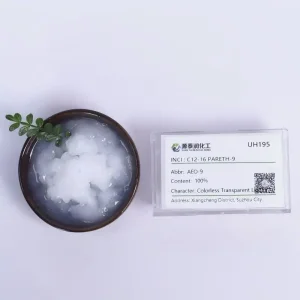
- Medium EO Ethoxylates (AEO-7, AEO-9): Feature balanced HLB values (11–13.5). Highly water-soluble, these grades represent the peak of wetting speed and detergency, making them the standard choice for home-care laundry detergents and industrial degreasers.
- High EO Ethoxylates (AEO-15, AEO-20): Highly hydrophilic (HLB > 15), acting as excellent dispersing agents, solubilizers, and stabilizers for complex emulsion systems, such as crop protection formulations and skincare creams.
Global Commercial and Industrial Landscape
The demand for alcohol ethoxylates is rising globally, driven by stringent environmental mandates pushing for the replacement of Alkylphenol Ethoxylates (APEOs) like Nonylphenol Ethoxylates (NPEOs). NPEOs have been largely banned or restricted in Europe (REACH regulations) and North America due to endocrine-disrupting properties and persistence in aquatic environments. AEO stands as the primary, highly biodegradable replacement candidate, boasting low toxicity profiles and rapid environmental decay.
The European market leads the integration of ultra-pure AEO variants, particularly in personal care, while APAC dominates in terms of mass-scale industrial cleaning consumption. Rapid urbanization, combined with rising disposable income in developing nations, has driven unprecedented demand for concentrated liquid detergents, which heavily rely on AEO-7 and AEO-9 due to their superb formulation stability under cold-water conditions.
Sourcing Strategy: Leveraging the Chinese Chemical Cluster Efficiency
For international buyers, importing Fatty Alcohol-Polyoxyethylene Ether from China offers structural economic advantages that extend beyond low labor rates. The core competitiveness of Chinese AEO factories is built upon three pillars:
- Raw Material Co-location: Large-scale ethoxylation plants in zones like the Suzhou and Nanjing Chemical Parks are located adjacent to world-class ethylene oxide (EO) petrochemical hubs. Because EO is highly hazardous to transport, pipeline integration ensures an uninterrupted, cost-efficient supply chain directly into ethoxylation reactors.
- Advanced Continuous Alkoxylation Loop Reactors: Modern facilities employ pressurized loop reactors instead of traditional batch reactors. This technology reduces the presence of unreacted alcohols, resulting in lower VOC emission levels and narrow polydispersity indices (NPD) for high-grade formulations.
- Regulatory Alignment & Safety Auditing: Leading Chinese manufacturers are fully compliant with ISO 9001, ISO 14001, and REACH pre-registrations, enabling smooth export procedures to Europe, the Americas, and Southeast Asia.