High-Quality Cocoamyl Propyl Betaine Suppliers & Factory

Premium Amphoteric Surfactants & Raw Material Engineering for Global Personal and Home Care Brands

Executive Technical Whitepaper

Comprehensive overview of Cocoamyl Propyl Betaine (Cocamidopropyl Betaine CAS 61789-40-0) molecular synthesis, performance mechanisms, and global procurement trends.

1. Fundamental Molecular Architecture & Mechanics

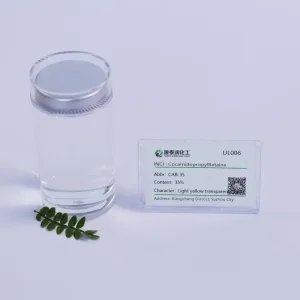
Cocoamyl Propyl Betaine (commonly designated within industry standards under the broader IUPAC and cosmetic taxonomy as Cocamidopropyl Betaine or CAB-35) is an amphoteric, zwitterionic surfactant. Structurally, it features a fatty acid amide portion (derived from natural coconut oil or palm kernel oil containing chains from $C_8$ to $C_{18}$) linked via a propylenediamine group to a quaternary ammonium betaine group.

Unlike traditional anionic surfactants such as Sodium Lauryl Sulfate (SLS) or Sodium Laureth Sulfate (SLES), the molecular charge of Cocoamyl Propyl Betaine is pH-dependent. In acidic formulations, it exhibits cationic behaviors, boosting hair conditioning benefits and viscosity response. In alkaline and neutral media, it operates zwitterionically, acting as an exceptional foam stabilizer and mild co-surfactant. This makes it an indispensable component for mitigating the skin-irritation indexes of primary alkyl sulfates while maintaining superior micellar stability.

2. Global Procurement Outlook & Macro Supply Dynamics

The global demand for high-active amphoteric surfactants is experiencing rapid expansion due to the rapid growth of "Clean Beauty" and the rising demand for sulfate-free personal care cosmetics. According to global chemical trade statistics, market demand for high-purity Cocoamyl Propyl Betaine is projected to exceed 500,000 metric tons annually by 2028.

Enterprise buyers prioritize sourcing from factories that guarantee low trace impurities. In particular, controlling levels of Monochloroacetic Acid (MCA) and Dichloroacetic Acid (DCA)—as well as free amidoamines (DMAPA)—is critical for compliance with the EU's Scientific Committee on Consumer Safety (SCCS) guidelines. Suzhou Yuantairun Chemical implements advanced catalytic technologies to maintain DMAPA levels below 50 ppm, assuring our global partners that our supplies remain safe for delicate baby care formulations and ophthalmic applications.

3. Key Technical Specification Matrix

Parameters Standard Grade (CAB-35) Ultra-Pure High Active Grade Analytical Method
Active Matter (%) 30.0 - 32.0 35.0 - 37.0 ISO 2271
Free Amidoamine (DMAPA) ≤ 0.02% (200 ppm) ≤ 0.005% (50 ppm) HPLC-MS
Sodium Chloride (%) 4.5 - 6.0 ≤ 3.0 Argentometric Titration
pH (5% Aqueous Solution) 4.5 - 6.5 5.0 - 7.0 pH Meter (GB/T 13531.1)
Free Fatty Acid (%) ≤ 0.5 ≤ 0.2 Acid-Base Titration
Color (Gardner) ≤ 2.0 ≤ 1.0 Colorimetry

Procurement Checkpoints

When buying bulk amphoteric surfactants, verify these chemical properties to prevent downstream formulation failures:

  • Viscosity Stability: Low sodium chloride alternatives prevent premature thickening in cold storage.
  • Color Preservation: Low Gardner index minimizes the requirement for chemical bleaching agents.
  • Eco-Certifications: Verify RSPO Mass Balance supply chain certification to align with corporate ESG goals.

About YuantaiRun Chemical

A leading daily chemical raw materials supplier dedicated to bringing cutting-edge solutions, R&D integration, and reliable supply chain logistics globally.

YuantaiRun Facility
Warehouse Operation Lab Testing

As a leading supplier in the daily chemical raw materials industry, Suzhou Yuantairun Chemical Co., Ltd. is dedicated to delivering high-quality products and comprehensive one-stop services to support our customers in R&D, production, and supply chain optimization. Our mission is to drive innovation and efficiency in the global daily chemical industry by providing cutting-edge solutions tailored to our clients' needs.

Our core competence lies in our state-of-the-art manufacturing integration, which allows us to process high-purity amphoteric surfactants like Cocamidopropyl Betaine alongside critical moisturizing, emulsifying, and preserving agents. We work closely with brand chemists and industrial procurement teams to design custom specifications, offering flexible ODM/OEM solutions to scale up from pilot to high-volume commercial production.

2010
Founded In
7000+
Cooperative Partners
99.9%
Quality Pass Rate

One-Stop Services

We provide a rich, comprehensive portfolio of cosmetic surfactants, thickeners, and preservatives, ensuring your formula components are integrated seamlessly and economically.

R&D and Lab

Our specialized research facilities support ODM/OEM customizations, helping you adapt formulation viscosity, foaming speed, and sensory characteristics for specific regional target markets.

Moderate Pricing

By leveraging advanced automation in raw material synthesis, YuantaiRun guarantees superior chemical quality at highly competitive wholesale rates, lowering your raw material expenses.

Just-in-Time Delivery

Integrated supply networks and local logistics hubs ensure that ingredients are delivered on schedule to align with your production runs, avoiding stockouts.

Industry Solutions & Applications

Engineered formulations for home care, personal hygiene, and industrial degreasing systems.

Gentle Amino Acid Facial Cleanser

Application: Personal Care (Facial Cleansers, Body Wash)

Features Sodium Cocoyl Glutamate and Sodium Lauroyl Sarcosinate (LS-100N) for ultra-mild cleansing. The addition of Cocoamyl Propyl Betaine generates a luxurious, stable foam texture while retaining natural skin moisture. Meeting global clean beauty demands, this formulation is highly recommended for sensitive skin.

High-Foaming Shower Gel Formulation

Application: Personal Care (Shower Gels, Shampoos)

Combines amphoteric CAB-35 (Cocamidopropyl Betaine) and non-ionic APG1214 (Lauryl Glucoside) to generate a rich, dense lather that rinses cleanly. This sulfate-free formulation minimizes skin dryness, incorporates Xanthan Gum for viscosity management, and is gentle enough for infant care products.

Eco-Friendly Laundry Detergent

Application: Home Care (Laundry Detergents, Multi-surface Cleaners)

Employs SLES (Sodium Laureth Sulfate) and AOS (Sodium Alpha-Olefin Sulfonate) as core actives, stabilized by Cocamidopropyl Betaine. It achieves powerful grease removal, excellent stability across hard water environments, and maintains low ecotoxicity profiles to meet modern ecological standards.

Industrial Heavy-Duty Degreaser

Application: Industrial Cleaning (Machinery, Vehicle Oil Removal)

Powered by LAS (Linear Alkylbenzene Sulfonate) and solvent EGDS (Glycol Distearate) to break down tough grease quickly. Our formulation utilizes a specialized betaine co-surfactant to improve alkaline builder compatibility, accelerating wetting and cleaning performance.

Technical Roadmap & Future Outlook

How we are developing green chemistry solutions for the personal care industry over the next decade.

Decarbonization & Bio-Based Raw Material Sourcing

Sustainable sourcing is central to our R&D direction. Traditional Cocoamyl Propyl Betaine synthesis relies on dimethylaminopropylamine (DMAPA), a petroleum-derived tertiary amine. Yuantairun's research team is developing bio-derived amine alternatives using catalytic amination of bio-sourced alcohols. This process yields a 100% bio-based betaine surfactant that matches the surfactant profile of conventional CAB-35.

Cold-Process Formulation Support

Global cosmetic manufacturers face the challenge of reducing energy consumption during processing. Standard formulations require heating surfactants to incorporate solid thickeners or pearlescent agents (like EGDS). We are optimizing our liquid Cocoamyl Propyl Betaine concentrates to have lower gel-phase temperatures, enabling stable room-temperature mixing. This technology reduces energy costs and simplifies processing steps for personal care manufacturers.

Impurity Minimization Pathways

In line with global consumer safety trends, our factory uses advanced vacuum distillation and thin-film evaporation to strip volatile residual amines and halogenated organic trace compounds. These processing improvements lower free DMAPA levels to less than 10 ppm, meeting strict clinical patch testing and hypoallergenic cosmetic product standards.

R&D Target Milestones

  • 2026: Achieve 100% RSPO Mass Balance compliance for all raw coconut/palm derivatives exported to the EU.
  • 2027: Introduce zero-solvent, low-salt high-active powder betaines (85% active concentration).
  • 2028: Transition production utilities to 50% carbon-neutral sources.

Local Support & Compliance Assurance

Ensuring compliance with international chemicals regulations, customs clearances, and technical support frameworks.

REACH & TSCA Alignment

Our Cocoamyl Propyl Betaine holds full REACH registration in the EU and is registered on the United States TSCA inventory. We provide extensive SDS documents in 15 languages, detailing proper handling, transport classifications, and toxicity profiles.

Eco-Labeling and Certifications

For brands developing eco-friendly formulations, our raw ingredients comply with Ecocert, COSMOS, and NPA standards. This supports your claims of natural origin, high biodegradability, and cruelty-free manufacturing.

Global Logistics & Packing Options

Whether you require delivery in 200kg plastic drums, 1000kg IBC tanks, or bulk ISO containers, our logistics team manages customs clearances and shipping to major industrial hubs globally, ensuring secure transit.

Technical Q&A / FAQ

Addressing common formulation questions and industrial sourcing queries for Cocoamyl Propyl Betaine.

What is the distinction between Cocoamyl Propyl Betaine and Cocamidopropyl Betaine?

In practical trade and chemical databases, "Cocoamyl Propyl Betaine" and "Cocamidopropyl Betaine" (CAS No. 61789-40-0) are used interchangeably to refer to the same class of alkyl amido betaines. The term "cocoamyl" reflects the natural distribution of amyl and alkyl fatty acid chains derived from raw coconut oil. Both exhibit the same zwitterionic behavior, conditioning benefits, and viscosity-enhancing properties in personal care formulations.

How does CAB-35 act as a rheology modifier (thickener)?

Cocamidopropyl Betaine modifies rheology by interacting with anionic surfactants like SLES. It promotes the transition of spherical micelles into rod-like micelles. This structural change increases entanglements within the micellar network, resulting in higher formula viscosity without the need for large quantities of salt or synthetic polymer thickeners.

What measures are taken to ensure low levels of free DMAPA in your products?

Suzhou Yuantairun Chemical utilizes a post-synthesis purification step using vacuum distillation. This process strips residual dimethylaminopropylamine (DMAPA) and other volatile reaction byproducts. This keeps the free DMAPA content consistently below 50 ppm, minimizing skin sensitization risks and meeting baby-safe product standards.

What are the recommended storage parameters for bulk liquid betaine surfactants?

We recommend storing bulk liquid betaine surfactants at temperatures between 15°C and 35°C in clean, corrosion-resistant stainless steel or plastic storage tanks. Exposure to temperatures below 10°C may cause crystallization or separation, which can be reversed with gentle heating and mixing. Avoid direct contact with strong acids or oxidizing agents to preserve product stability.

Industry News & Insights

Stay updated on the latest chemical trends, formulation science, and surfactant innovations.

2026-03-06

Runtec®SCI85: Premium Mild Anionic Surfactant

Runtec®SCI85 is a high-active ingredient mild anionic surfactant designed to provide a gentle, clean skin feel. It is highly compatible with amphoteric surfactants, helping chemists develop non-irritating formulations for sensitive skin care.

2026-02-02

Runtec®SCA-30: Sodium Cocoyl Alaninate

Designed for high-performance shampoos, Runtec®SCA-30 is an oil-resistant amino acid surfactant that generates rich foam, providing excellent cleansing while preserving natural lipid barriers.

2026-01-31

Cetyl Ethylhexanoate: Synthetic Ester Emollient

Commonly referred to as synthetic seabird feather oil, this skin-conditioning emollient is compatible with various cosmetic oils. It offers excellent spreadability and a non-greasy after-feel.

Optimize Your Surfactant Supply Chain

Get in touch with our technical sales engineers for specification sheets, free lab samples, and customized contract pricing.

Send Inquiry Now